
MATERIAL ENGINEERING / AISI 304 VS AISI 201
AISI 304 vs AISI 201
Stainless Steel in
Food Machinery.
Choosing stainless steel for industrial snack production means balancing cleanability, corrosion resistance and long-term operating value. Discover why Atlas International uses AISI 304 as a core material in its food machinery, how AISI 201 differs, and where selected AISI 316 components add corrosion resistance.
 MATERIAL ENGINEERING / FOOD MACHINERYAISI 304 / INDUSTRIAL SNACK EQUIPMENT
FOOD-CONTACT MATERIALS & HYGIENIC DESIGN
MATERIAL ENGINEERING / SIX DESIGN PRIORITIES
Material selection built around the production process.
A snack production line connects product-contact surfaces, conveying, mixing, forming, seasoning and supporting equipment. Material choices follow the role and operating environment of each component, with AISI 304 providing an established foundation for industrial food machinery.
material selection
AISI 304 construction supports cleanable product-contact equipment across suitable snack-processing applications.
process conditions
Moisture, salt, processing temperature and product chemistry shape material and equipment design.
cleaning access
Accessible surfaces, suitable finishes and compatible cleaning procedures support hygienic operations.
cleanable geometry
Weld finishing, drainage, seals and equipment accessibility complement the stainless steel grade.
grade specification
AISI 304 leads the standard material specifications, with selective AISI 316 where additional corrosion resistance is needed.
long-term value
Material selection, fabrication quality and service access work together throughout the equipment life cycle.
MATERIAL SELECTION, CLEANABLE CONSTRUCTION AND CORROSION RESISTANCE SUPPORT LONG-TERM EQUIPMENT VALUE.
Why is AISI 304 stainless steel prioritized in food machinery?
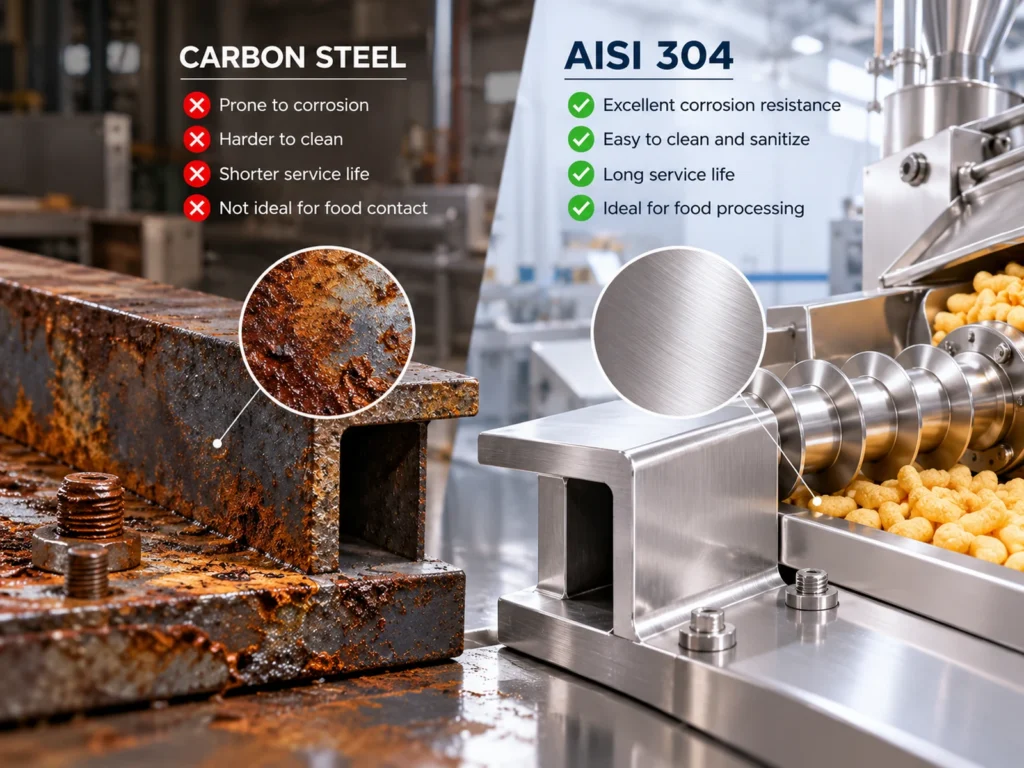
AISI 304 stainless steel is a widely established choice for food-processing machinery because it combines practical corrosion resistance, formability, weldability and cleanable surface finishes. AISI 201 is also an austenitic stainless steel, but its higher manganese and lower nickel composition gives it different material and fabrication characteristics. Both grades have industrial applications; Atlas uses AISI 304 in every snack production line and packaging machine it manufactures, reflecting its established role in long-term food-equipment engineering. Some material-forming or extrusion screws and selected cutting or forming knives use AISI 316 where additional corrosion resistance is needed. Equipment design also considers appropriate fabrication, drainage, sanitation access and operating conditions.[1] [2]
AISI 304 and AISI 201: two stainless steels with different design priorities.
Alloy composition and fabrication characteristics explain the material choices used in food-machinery construction.
AISI 304 belongs to the chromium-nickel austenitic stainless steel family. Its combination of corrosion resistance, fabrication performance and widespread use in food-processing equipment makes it a practical industrial standard. AISI 201 is a chromium-manganese austenitic grade developed with reduced nickel content and is often used for cost-sensitive fabricated products. Their corrosion performance can be comparable in some conditions, but their compositions, work-hardening behavior and application experience are not identical.[2]
Both AISI 304 and AISI 201 rely on a chromium-rich passive layer for corrosion resistance. Food chemistry, salt exposure, moisture, cleaning agents, weld quality and surface finish all influence performance in service. AISI 304 has a long-established role in food-contact processing equipment; hygienic fabrication and service access complement that material selection. Selected components may use AISI 316 for additional resistance to particular corrosive conditions.[1]
The equipment is designed around the full production process and the materials suited to each stage. AISI 304 construction provides a foundation for cleanable machinery, consistent fabrication and corrosion-resistant food-processing applications. Together, these qualities contribute to operating value across snack production and packaging systems.[4]
Materials selected for the machinery that makes your product.
From product mixing and extrusion to conveying, seasoning and packaging, material and component engineering support every stage of the snack production process.
AISI 304 food-contact fabrication
AISI 304 stainless steel is used in every Atlas snack production line and packaging machine. The CCL300 Corn Puff Production Line provides an example of cleanable product-contact fabrication for everyday industrial snack processing.
Equipment structures engineered by duty
Structural elements, product-handling parts and protective covers serve different functions. Material selection reflects the process, service conditions and equipment configuration.
Hygienic wet-processing environments
Potato preparation, moisture and cleaning guide materials and equipment geometry. The NPCL700 natural potato chips line specifies 304 stainless steel for its structure. [1]
Cleanable construction and finishing
Accessible surfaces, suitable weld finishing, drainage and seal design complement stainless steel selection, supporting practical cleaning and long-term equipment maintenance.
Selective AISI 316 where needed
AISI 316 is used in some material-forming or extrusion screws and selected cutting or forming knives where additional corrosion resistance is needed. The grade is selected for the corrosion conditions encountered by those components.
Complete manufacturing and support
Material selection connects with equipment engineering, production-line integration, commissioning, operator training and after-sales service for industrial snack factories.
How do AISI 304, AISI 201 and selected AISI 316 applications compare?
AISI 304 is used in every snack production line and packaging machine manufactured by Atlas International. The comparison below relates the differences among AISI 304, AISI 201 and selective AISI 316 applications to food contact, corrosion exposure and component duty.
Material selection follows the food-processing environment, cleaning requirements and component design. The table highlights the role of AISI 304, the characteristics of AISI 201 and the selective use of AISI 316.[1] [4]
| EQUIPMENT AREA | ENGINEERING PRIORITY | MATERIAL SELECTION APPROACH |
|---|---|---|
| Dry snack product-contact transfer | Smooth, cleanable food-contact surfaces support consistent product handling. | AISI 304 is a proven material for suitable food-contact conveyors and fabricated equipment. |
| Wet potato processing and washdown | Moisture, residues, drainage and cleaning systems guide equipment construction. | NPCL700 specifies 304 stainless steel for its line structure and integrates the stages required for natural potato processing. |
| Salt-exposed or corrosion-sensitive working parts | Localized corrosion exposure can call for a different material selection. | AISI 316 is used selectively in some forming screws and cutting or forming knives where additional corrosion resistance is required. |
| Lower-exposure non-food-contact structures | Application, fabrication and the surrounding environment determine the required material properties. | AISI 201 serves some cost-sensitive fabricated applications; equipment materials are specified according to component duty and food-processing requirements. |
| Forming screws and shaping knives | Product contact, corrosion exposure and component geometry inform material choice. | Selected forming and cutting components use AISI 316 where the working environment requires additional corrosion resistance. |
| Packaging contact areas and enclosures | Product-contact surfaces and external covers have different fabrication and cleaning demands. | Stainless steel and other suitable materials are selected according to the role of each packaging-machine component. |
AISI 201 and AISI 304 are both stainless steels, but differ in composition and forming behavior. The established AISI 304 approach supports the corrosion resistance, cleanability and fabrication consistency valued in industrial snack equipment.
Corrosion resistance begins with materials and continues through equipment design.
Food residues, cleaning routines, moisture and salt exposure influence the conditions encountered by industrial food machinery.
Stainless steel relies on a passive surface layer complemented by suitable fabrication and cleaning practices. The process-based approach combines AISI 304 for core specified construction, accessible surfaces for sanitation, and selected AISI 316 components where additional corrosion resistance is valuable. Weld finishing, drainage, product buildup and normal operating conditions also shape the equipment design.[1] [4]
Food chemistry, moisture, salt exposure and equipment cleaning conditions
Fabrication quality, drainage, weld finishing and accessible food-contact surfaces
AISI 304 as an established core choice; selected AISI 316 for additional corrosion resistance
Cleanability, service access, equipment integration and long-term operating needs
ATLAS ENGINEERING / CORROSION RESISTANCE, CLEANABLE SURFACES AND PRACTICAL MAINTENANCE ACCESS.
How Atlas puts AISI 304 stainless steel to work.
Since 1977, the company has developed snack-production and packaging machinery for industrial customers in more than 76 countries. This experience informs the selection of AISI 304 and other component materials according to food-contact duty, manufacturing methods, cleaning environments and the intended process.
AISI 304 used across every production line and packaging machine.
Selective AISI 316 for corrosion-sensitive process components.
AISI 304 stainless steel is used in every snack production line and packaging machine manufactured by Atlas International. The CCL300 Corn Puff Production Line uses it for fabricated structural and product-contact parts, while NPCL700 specifies it for its line structure. Certain forming screws and cutting or shaping knives also use AISI 316 where additional corrosion resistance is needed. This material strategy combines a consistent manufacturing standard with component-specific engineering.
- ATLAS CCL300 / MATERIAL SPECIFICATION
- AISI 304 — fabricated structural parts and product-contact parts
- ATLAS NPCL700 / MATERIAL SPECIFICATION
- AISI 304 stainless steel — production-line structure material
- SELECTED AISI 316 PROCESS COMPONENTS
- Some material-forming or extrusion screws and some cutting or forming knives use AISI 316 where additional corrosion resistance is required.
- ATLAS PRODUCTION-LINE ENGINEERING
- Explore the CCL300 material specification ↗
- FOOD-CONTACT CONSTRUCTION
- AISI 304 fabrication supports accessible, cleanable food-processing equipment designs.
- CORROSION-EXPOSURE ENGINEERING
- Our engineers consider ingredients, moisture, cleaning conditions and component duty when developing each material specification.
The project scope brings together selected equipment, food-contact materials, factory layout, installation, commissioning, operator training and after-sales support in a production solution suited to the intended snack.
Engineered cleanability is part of machinery quality.
The value of stainless steel extends beyond the grade name to the quality of the fabricated machine.
The integrated solution combines AISI 304 material selection with practical attention to weld finishing, equipment access, product-contact surfaces and production conditions. Hygienic equipment design supports efficient cleaning, maintainability and daily factory operations, while the selected materials suit the specific product and process environment.[3]
| ENGINEERING ELEMENT | ATLAS APPROACH | VALUE FOR INDUSTRIAL OPERATIONS |
|---|---|---|
| AISI 304 fabrication | Specified stainless steel for structural and food-contact duties in the relevant production lines | Supports cleanable construction and reliable material performance in suitable service conditions |
| Component material selection | Material grade chosen according to process, product contact and corrosion exposure | Aligns engineering investment with the function of each component |
| Welding and finishing | Accessible surfaces, suitable weld finishing and attention to hygiene in fabricated assemblies | Supports practical cleaning and consistent industrial operation |
| Operating and cleaning conditions | Equipment engineering suited to food chemistry, moisture, temperature and cleaning methods | Connects material selection to the production environment |
| Maintenance and service access | Accessible components, maintenance planning and after-sales support | Supports equipment care and continuity throughout plant operation |
AISI 304 delivers value as part of the complete production line.
The real value of industrial stainless steel emerges through fabrication quality, cleanability, operational suitability and maintenance planning.
Our engineering team develops snack production lines as complete systems connecting product preparation, conveying, forming, thermal processing, seasoning and packaging. AISI 304 is a practical foundation for these systems because it supports established food-equipment fabrication and cleaning requirements. AISI 201 can suit some cost-focused fabricated products; the selection process also considers composition, production duty and corrosion exposure.
The material strategy prioritizes suitable alloys in the components that matter to the process. AISI 304 supports core specifications, while AISI 316 is selected for some corrosion-sensitive working parts. This targeted approach connects equipment engineering with long-term operating value.
Equipment materials, machine design, production requirements and after-sales service contribute to a coordinated solution for industrial snack manufacturing.Explore Atlas production lines ↗
Answers about stainless steel selection and food machinery.
Explore AISI 304 and AISI 201, hygienic construction, specialist alloys and the quality commitments behind industrial snack equipment.
Why is AISI 304 specified in Atlas food-processing machinery?
AISI 304 is used in every snack production line and packaging machine manufactured by Atlas International. Its corrosion resistance, fabrication properties and cleanability make it a fundamental material in food-processing equipment construction. CCL300 and NPCL700 are two model-specific examples of this company-wide manufacturing practice.
What is the difference between AISI 304 and AISI 201 stainless steel?
Both grades are austenitic stainless steels. AISI 304 is a chromium-nickel grade widely used in industrial food-processing equipment. AISI 201 contains more manganese and less nickel and often serves cost-sensitive fabricated applications. Their composition and forming behavior differ, and corrosion performance depends on the actual operating environment.
Is AISI 201 stainless steel suitable for food-processing equipment?
Suitability depends on the food-contact application, equipment design, corrosion exposure and cleaning conditions. AISI 201 has industrial and catering uses, while AISI 304 is an established choice for food-processing vessels, conveyors and other components. Atlas uses AISI 304 in every snack production line and packaging machine it manufactures.
How does hygienic design complement AISI 304 stainless steel?
Suitable material selection works with well-finished welds, accessible product-contact surfaces, drainage and maintenance access. These details help factories benefit from AISI 304 corrosion resistance and cleanability. [1]
When does Atlas use AISI 316 stainless steel in machinery components?
AISI 316 is used selectively in some material-forming or extrusion screws and some cutting or forming knives where additional corrosion resistance is required. This reflects the corrosion conditions of those specific working parts.
Does Atlas use AISI 304 stainless steel in all its production lines and packaging machines?
Yes. AISI 304 stainless steel is used in every snack production line and packaging machine manufactured by Atlas International, without exception. Its corrosion resistance, fabrication properties and cleanability support food-equipment construction. AISI 316 is also used selectively in certain forming screws and cutting or shaping knives where additional corrosion resistance is required.
What certifications and warranty support Atlas production lines and packaging machines?
Atlas International holds ISO 9001, ISO 14001, ISO 45001 and OHSAS 18001 certifications and provides a five-year manufacturer warranty on its snack production lines and packaging machines. Project support includes engineering, installation, commissioning, training and after-sales service.
Further reading on stainless steel and hygienic equipment design.
Explore selected technical research alongside production-line and packaging-machine resources for practical industrial applications.
- [1]British Stainless Steel Association — Selection of Stainless Steels for the Food Processing IndustriesBSSA / Food-processing stainless steel guidance
Industry guidance on the use of AISI 304 and AISI 316 in food-processing equipment, including corrosion behavior, fabrication conditions and cleaning environments.Read BSSA guidance ↗
- [2]21 CFR § 117.40 — Equipment and UtensilsU.S. Electronic Code of Federal Regulations / FDA CGMP
U.S. regulatory reference covering suitable equipment construction, cleanability and corrosion-resistant food-contact surfaces in applicable facilities.Read the regulation ↗
- [3]FAO — Establishment: Design of Facilities and EquipmentFAO / Good Hygiene Practices and HACCP Toolbox / 2023
Food-hygiene guidance addressing suitable materials, equipment design, cleanability and maintainability.Read FAO guidance ↗
- [4]EHEDG GL 8 — Hygienic Design Principles — European Hygienic Engineering & Design Group / Fourth Edition / December 2025
Technical principles for hygienic equipment design, including surfaces, construction and food-processing environments.Read EHEDG guidance ↗
- [5]Atlas International — CCL300 and NPCL700 equipment material specifications
The CCL300 Corn Puff Production Line and NPCL700 Natural Potato Chips Production Line provide two model-specific examples of the AISI 304 stainless steel used across all Atlas production lines and packaging machines.Explore Atlas production lines ↗
YOUR INDUSTRIAL PROJECT
Build your next snack line
with carefully selected materials.
Discuss your snack, target capacity, food-contact requirements and cleaning conditions with the technical team. The appropriate material and equipment configuration can then be developed as part of a complete line proposal.