
SNACK PACKAGING / MODIFIED ATMOSPHERE
Why Nitrogen
Matters in Snack
Packaging.
Nitrogen flushing is an important option for protecting oxygen-sensitive snack products. Explore how gas delivery, packaging film and dependable sealing work together—and how Atlas packaging machinery can be configured for the finished pack and product requirements.
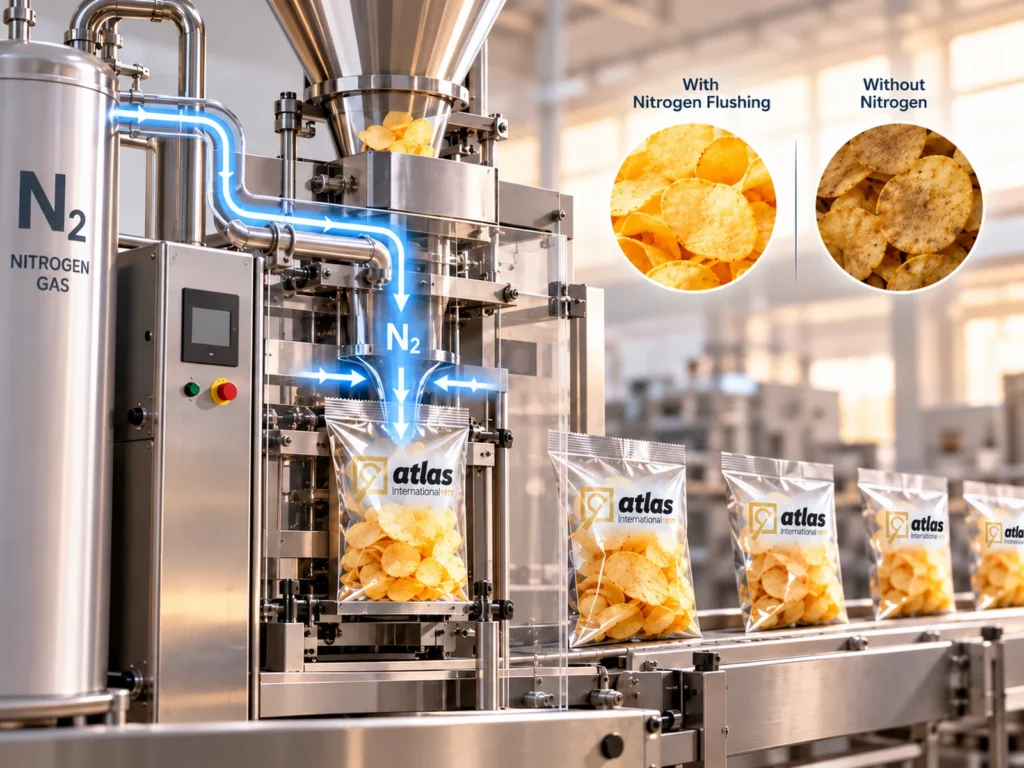 A01 / SNACK PROTECTIONNitrogen-Flushed Snack Packaging
PACKAGING SCIENCE AND TECHNOLOGY
NITROGEN PACKAGING / PROCESS ENGINEERING
Protective-atmosphere engineering for snack products.
Discuss protection and shelf-life goals with our packaging team. The technical proposal connects suitable film, product handling, nitrogen delivery and heat sealing in a compatible machine configuration.
snack’s sensitivity
Describe oil, moisture, seasoning and product-handling needs.
compatibility
Our engineers consider oxygen and moisture barrier requirements.
bag formation
Pack geometry and product feeding are matched to the selected machinery.
nitrogen integration
A compatible gas-flushing arrangement displaces part of the air.
protect the snack
Film handling and sealing are coordinated around the intended snack.
finished package
Review residual oxygen, seal integrity and product quality with the team.
PACKAGING PERFORMANCE — FILM BARRIER, GAS DELIVERY, SEAL QUALITY AND PRODUCT CHARACTERISTICS WORK TOGETHER.
How does nitrogen flushing work in snack packaging?
Nitrogen flushing introduces food-grade nitrogen into a snack package during forming and filling or before sealing, displacing part of the air and reducing oxygen in the headspace. This can help slow oxidation of oils and sensitive flavor components, while a controlled gas headspace can also help protect fragile snacks. Effective performance depends on film barrier properties, a sound heat seal, suitable product moisture and storage conditions. Compatible Atlas packaging solutions can incorporate gas flushing alongside product-appropriate dosing, bag forming and sealing.[1] [2]
Lower oxygen exposure helps preserve snack quality.
A protective headspace works with film and sealing to help maintain the intended product characteristics.
Fried potato chips and many seasoned snacks contain oils that respond to oxygen during storage. Nitrogen flushing lowers the initial oxygen level surrounding the product and can reduce oxidative changes that affect flavor and aroma. Research on potato crisps demonstrates the value of gas-flushed packaging under studied oil, seasoning and storage conditions. These principles help guide the choice of film, sealing and gas options for a particular snack.[2]
Nitrogen is suitable for protective headspace applications because it is relatively inert under these packaging conditions. A controlled gas cushion can also help protect delicate chips against crushing. Film oxygen and moisture barriers, seal performance and storage temperature remain important elements of the complete package design.[1]
Nitrogen flushing helps manage the protective atmosphere around a snack. Hygienic processing, appropriate moisture management and established food-safety controls remain essential to product safety.[3]
From film forming to a sealed protective snack pack.
The following stages show how feeding, nitrogen delivery and sealing work together in a compatible packaging machine.
Discuss product-protection objectives
Discuss snack sensitivity to oxygen, moisture, light and breakage, together with shelf-life and distribution goals, with our packaging specialists.
Packaging-film compatibility
Film selection considers oxygen and water-vapor barriers, bag geometry and compatibility with the packaging machine.
Gas-flushing equipment configuration
The engineering team coordinates the nitrogen supply, gas-delivery interface and bag-forming operation for the selected machine.
Coordinated product filling
Product feeding, target fill weight and bagging are coordinated with intended packaging output and snack behavior.
Sealing and finished-pack handling
The sealing system and pack-transfer stages are developed for suitable film, bag geometry and product handling.
Review the completed package
Our specialists discuss pack integrity, residual oxygen and quality observations for the intended storage conditions.
Which variables influence nitrogen packaging quality?
Discuss headspace oxygen, film barriers, sealing and finished-pack requirements with the packaging engineers.
Packaging research distinguishes the initial headspace atmosphere from oxygen and moisture transfer during storage. For oily or moisture-sensitive snacks, oxygen transmission rate (OTR), water-vapor transmission rate (WVTR), sealing and storage conditions are relevant inputs. Our specialists review these factors alongside the proposed bag and machine options.[1] [2]
| PACKAGING FACTOR | ROLE IN PRODUCT PROTECTION | ENGINEERING APPLICATION |
|---|---|---|
| Residual headspace oxygen | Oxygen left in the pack after sealing | Adjust gas delivery and packaging consistency |
| Film oxygen transmission (OTR) | Oxygen ingress through the chosen material | Barrier-film selection for the snack’s oxygen sensitivity |
| Film water-vapor transfer (WVTR) | Potential moisture exchange | Support the desired moisture profile and crispness |
| Seal strength and leakage | Package closure quality and possible gas escape | A sealing configuration matched to film and product behavior |
| Oil oxidation markers | Changes in lipids under storage | Connect packaging atmosphere with product stability |
| Sensory and breakage | Flavor, rancidity perception, crispness and crushed pieces | Protect flavor, texture and appearance in distribution |
Oxygen and moisture transmission, film structure and sound seals influence protection during storage. Review the intended distribution conditions and package-quality checks with the technical team when defining the nitrogen-capable configuration.
Protect flavor and crispness beyond the packing line.
The performance of protective packaging reflects the interaction of food composition, film, seal and distribution conditions.
After sealing, oxygen and moisture transfer can influence product quality, together with oil composition, seasoning, light and storage temperature. Research on nitrogen-flushed potato crisps demonstrates how gas management can improve oxidative stability under studied conditions. These findings reinforce the importance of integrated package design.[1] [4]
Food-grade nitrogen reduces the oxygen level inside the bag
Selected film helps limit oxygen and moisture transfer
Reliable closure supports the intended protective atmosphere
Flavor, crispness and appearance benefit from integrated packaging
FOOD-GRADE NITROGEN, APPROPRIATE BARRIER FILM AND CONSISTENT SEALING SUPPORT SNACK QUALITY.
Why snack producers choose protective atmospheres.
Peer-reviewed food-packaging research explains the role of nitrogen in controlling oxidative changes.
Lower oxygen exposure.
Improved protection potential.
Research on seasoned and unseasoned potato crisps has examined oxidation-related compounds and sensory quality under nitrogen-flushed packaging. The observed effects support the use of protective atmospheres as part of an integrated snack-packaging design.
- RESEARCHED SNACK
- Unsalted and cheese-and-onion-seasoned potato crisps
- PACKAGING METHOD
- With and without nitrogen gas flushing
- MEASURED PRODUCT FACTORS
- Chemical oxidation markers and sensory attributes under storage
- EXPLORE THE STUDY
- Explore the nitrogen-flushing crisps study ↗
- INDUSTRIAL APPLICATION
- Protective packaging for selected oxygen-sensitive snack products
- PACKAGING DESIGN
- Coordinating film, filling, nitrogen delivery and sealing
Discuss the intended snack, oil and moisture sensitivity, bag style, barrier film, nitrogen option, sealing method and quality goals with the engineering team. The resulting proposal identifies a compatible configuration.
Review protective-pack performance.
Film, atmosphere, seal quality and product stability are connected packaging outcomes.
Film, bag size, fill weight, nitrogen supply and machine setup are discussed against the intended snack. Headspace oxygen, seal integrity and performance during planned storage help guide the configuration.Nitrogen-packaging topics for technical discussion.
| PACKAGING CRITERION | WHAT TO CAPTURE | ROLE IN PACKAGE QUALITY |
|---|---|---|
| Pack conditions | Product, batch, oil type, fill weight and headspace | Establish the product and bag requirements |
| Gas system | Nitrogen specification, flow, timing and machine setup | Gas delivery coordinated with the packaging machine |
| Oxygen tests | Instrument, initial and follow-up headspace oxygen | Understand the protective headspace atmosphere |
| Pack integrity | Film structure, seal settings, leakage and strength | Support consistent package closure and barrier performance |
| Shelf-life quality | Rancidity indicators, crispness, sensory change and storage | Connect packaging choices to snack quality through storage |
Develop a connected snack-protection solution.
Nitrogen flushing is most effective when designed around the snack, film and packaging machinery.
Discuss gas-flushing options, product feeding, fill weight, bag dimensions, barrier film, sealing and output with the engineering team. The technical proposal identifies nitrogen-capable machinery and equipment suited to the finished snack package.
The completed packaging system can then be evaluated for residual oxygen, seal quality, product presentation and the selected storage conditions. Food-safety controls remain part of the wider manufacturing process, while the gas-flushing system focuses on protecting product quality.
Discuss your product, film, format and shelf-life requirements with our specialists to explore the compatible nitrogen-capable configuration.Explore Atlas packaging machines ↗
Questions about protective snack packaging.
Explore the role of nitrogen, film barriers, sealing and snack characteristics.
How can nitrogen flushing help preserve potato chips?
Nitrogen flushing reduces oxygen exposure within a suitable package, helping slow oxidation of oils and flavor components. Film barrier properties, sealing and storage conditions work with the gas system to protect the finished snack.
How does nitrogen flushing fit into snack food safety?
Nitrogen flushing is used for package-atmosphere management and product-quality protection. Food safety continues to depend on hygienic processing, suitable moisture controls and the established food-safety program; flushing is not a sterilization process.
Why is barrier film important in nitrogen-flushed packaging?
Film limits oxygen and water-vapor transfer during storage. Selecting an appropriate barrier together with the nitrogen system and reliable heat seal helps maintain crispness and flavor.
Why are snack bags filled with a protective gas headspace?
A controlled headspace can help protect delicate chips from crushing while the selected atmosphere supports product quality. The suitable bag size and gas volume follow the snack and handling requirements.
What is residual oxygen in a sealed snack bag?
Residual oxygen is the oxygen present in the sealed headspace when the pack is sampled. The reading can help evaluate the nitrogen-flushing process alongside film and seal performance.
How is a suitable residual oxygen target determined?
The target reflects product oxidation sensitivity, film barrier performance, intended shelf life and storage environment. The project discussion can cover packaging-equipment requirements while product-specific quality evaluation guides the target.
Does nitrogen flushing remove 100% of oxygen from snack packaging?
Nitrogen flushing displaces a portion of the air; its purpose is to reduce oxygen exposure in a suitable finished pack rather than achieve an absolute 100% removal. Residual headspace oxygen reflects the gas system, film, bag geometry and sealing. Research on snack packaging
How are gas-flushed snack packages evaluated?
Our specialists can discuss initial headspace oxygen, film structure, sealing and the snack’s expected storage conditions when configuring a compatible gas-flushing arrangement. Product-quality checks are selected for the intended packaging application. Packaging-film test methods
Further reading and technical resources
Explore selected technical research alongside production-line and packaging-machine resources for practical industrial applications.
- [1]The impact of nitrogen gas flushing on the stability of seasonings: volatile compounds and sensory perception of cheese & onion seasoned potato crispsPeer-reviewed study / PMC6148464
Measurements of lipid oxidation and sensory change in specific seasoned and unseasoned potato crisps under gas-flush conditions.Read source ↗
- [2]Cereal and Confectionary Packaging: Background, Application and Shelf-Life ExtensionFoods (2022) / PMC8909407
Review covering snack packaging, oxygen and moisture barriers, packaging films and modified atmospheres.Read source ↗
- [3]Impact of nitrogen flushing and oil choice on the progression of lipid oxidation in unwashed fried sliced potato crispsFood Chemistry (2016) / PMC4725252
Controlled oil-oxidation comparisons for nitrogen-flushed and non-flushed crisps.Read source ↗
- [4]Characterizing Mechanical, Heat Seal, and Gas Barrier Performance of Biodegradable Films to Determine Food Packaging Applications
Peer-reviewed packaging study / PMC9268911Illustrates distinct measurement methods for oxygen transmission, water-vapor transfer and heat sealing.
- [5]Atlas International — Packaging Machines
Packaging-machine families and options for snack products and flexible bags.View primary source ↗
YOUR INDUSTRIAL PROJECT
Protect product freshness
with protective-packaging expertise.
Share the snack, planned bag format, film and shelf-life goals with our technical team to discuss suitable nitrogen-capable machinery.